Digital Signage for Car Dealerships: The 2026 Guide
May 4, 20269 min readScreenivo Team
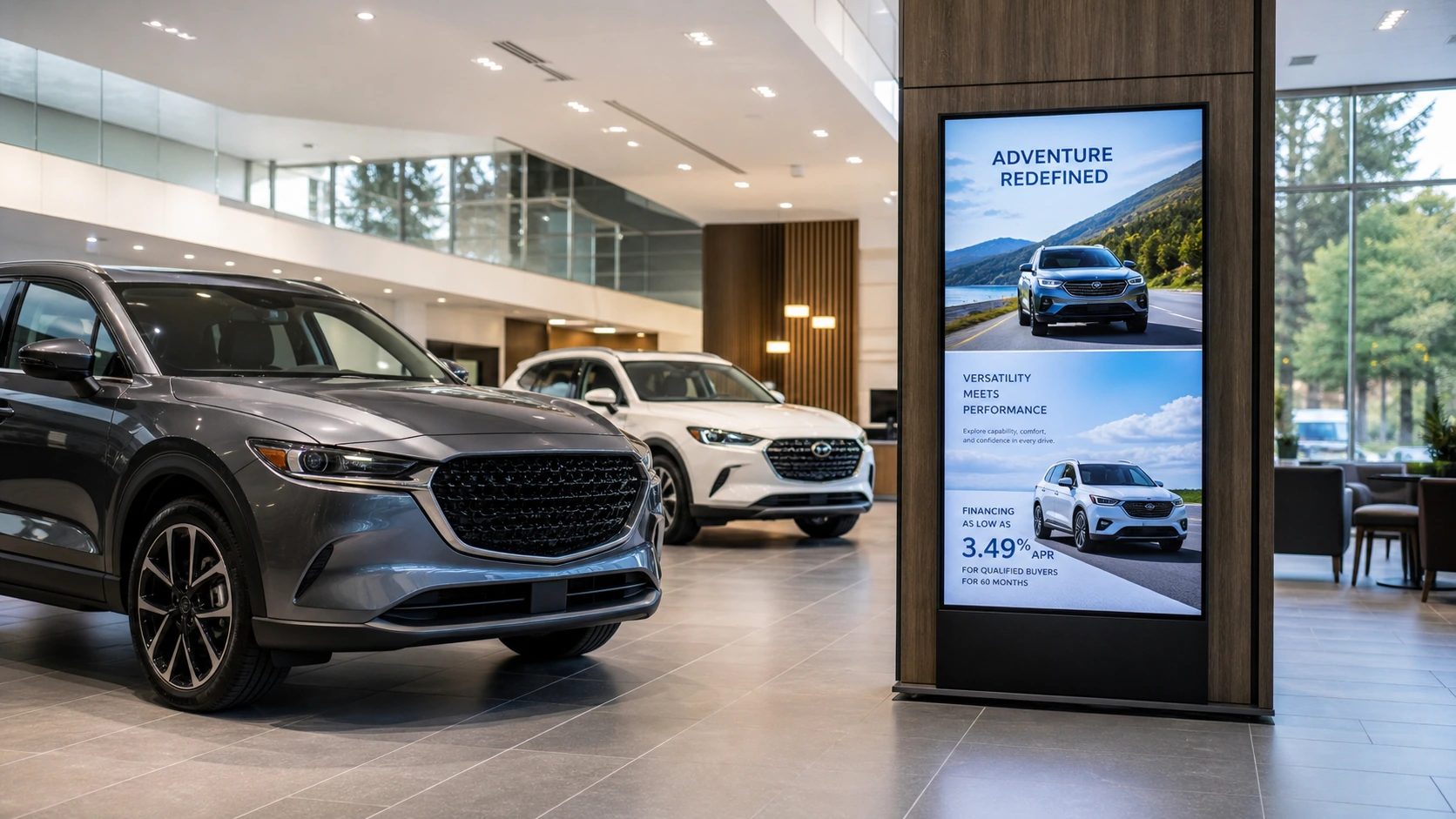
Most dealership screens are doing the easiest possible job. Cable news in the service lounge. A muted sports channel in the showroom. Maybe a stale slide loop somebody exported six months ago and never touched again.
That is a waste of expensive attention.
A car dealership is full of slow moments that matter. Shoppers circle the same SUV twice before asking a question. Service customers sit for 40 minutes wondering what else they should get done. Finance conversations drag because half the value is hard to explain on paper. Those are perfect signage moments if your screens are actually connected to the business.
Digital signage for car dealerships gives each screen a job. It helps sell the vehicle, explain the service offer, reinforce the trade-in message, and point people where to go. Just as important, it keeps the whole place looking current instead of patched together.
1. Why Most Dealership Screens Are Selling Nothing
The modern buyer already expects a digital-heavy shopping process before they walk into the store. Kelley Blue Book, reporting on Cox Automotive's 2024 Car Buyer Journey Study, says 82% of shoppers completed more than half the buying process online, and dealership satisfaction reached a record 81% among new-car buyers (source).
That matters because the in-store experience has to pick up where the online one left off. If the website feels current and transparent but the showroom TV is showing daytime talk shows, the handoff feels clumsy.
- Buyers arrive half-informed. They already know the trim names, rough payment range, and competing models. Your screens should help close the gap, not restart the conversation from zero.
- Idle screen time shapes perception. A polished model spotlight looks intentional. Random TV makes the showroom feel rented.
- Consistency builds trust. The same clean message across the lot, showroom, lounge, and finance area makes the dealership feel organized.
- Static print gets stale fast. Monthly payment examples, seasonal offers, and certified inventory messages all move too quickly for foam boards.
This is the same reason retail store signage works best when it is tied to the actual buying moment. The screen needs a job, not just electricity.
2. Showroom Screens Make Vehicles Feel More Premium
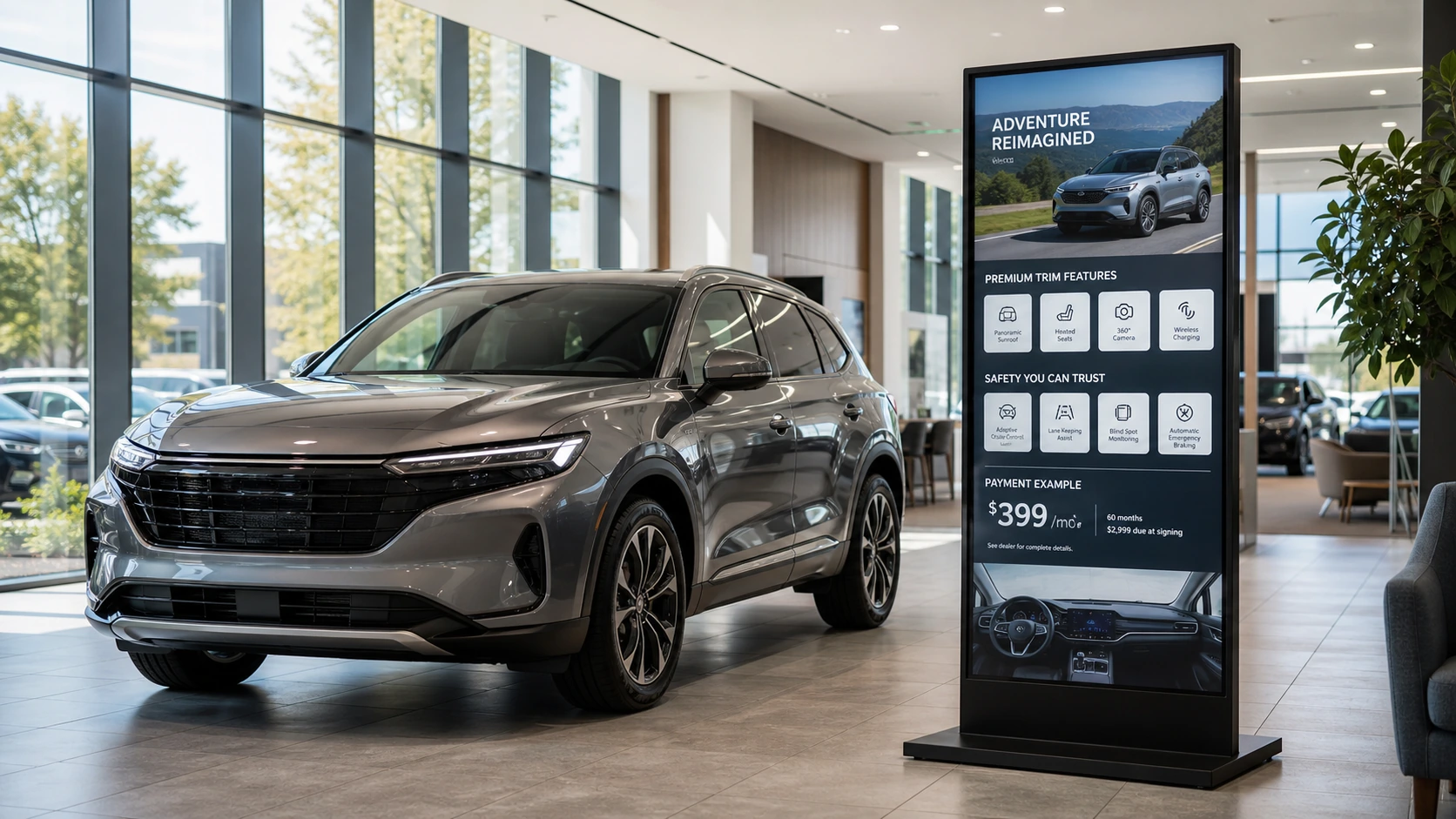
Cars are visual products. The trim details, interior tech, safety features, towing numbers, lease offers, and color options all compete for attention at once. A good showroom screen can simplify that without forcing the salesperson to do every bit of explaining live.
- Feature loops give shoppers context. Show the 360 camera, panoramic roof, cargo layout, towing capacity, or driver-assist package in motion instead of hoping a window sticker does enough.
- Model comparison gets easier. Put side-by-side slides for the two trims customers keep mixing up.
- Price and payment framing stays clean. A screen can rotate current finance examples, disclaimer-safe messaging, and trade-in prompts without cluttering the car itself.
- Brand perception improves. The vehicle feels more current when the presentation around it feels current too.
Research published in the Journal of Marketing in 2025 found that digital signage increased the likelihood of purchasing featured products by 8.1% across 237 campaigns and more than 30 million shopper observations, with stronger results when signage was close to the product (source). The study was not dealership-specific, but the takeaway still holds up well here: screens do their best work when they help a customer decide right where the decision is happening.
3. Service Waiting Areas Are Quiet Revenue Space
Most dealers work the front end hard and underuse the service lounge. That is strange, because service customers are already captive, already in a buying mindset, and already looking for updates.
J.D. Power's 2024 U.S. Customer Service Index Study found that owners of mass market vehicles waited an average of 5.2 days for a service appointment, while premium owners waited 5.4 days (source). When appointment slots are tight, every visit matters more. You do not want that waiting time to feel wasted.
Use service-lounge screens for:
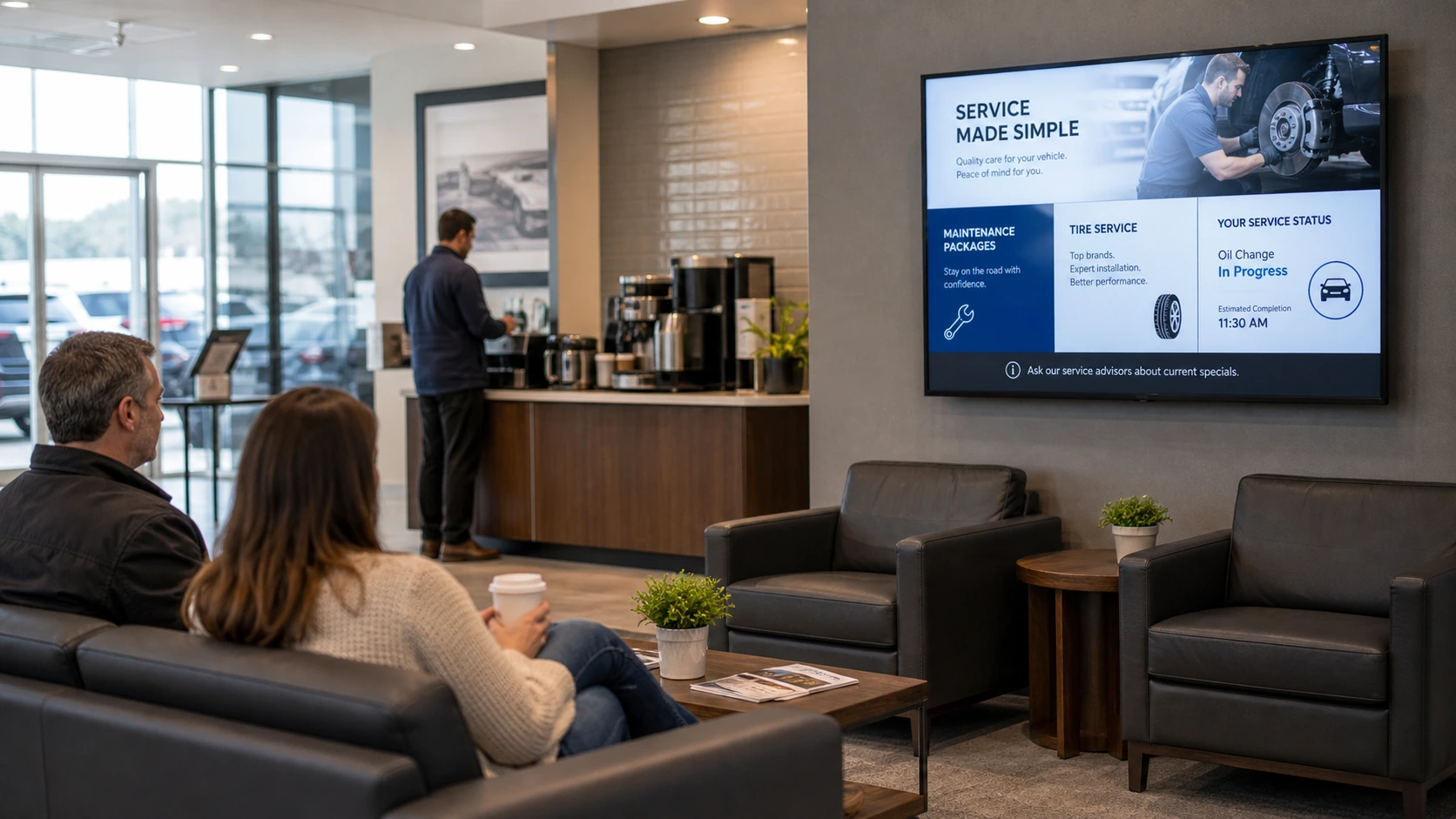
- Maintenance package explanations. Tire rotations, alignments, brake service, batteries, detailing, and prepaid maintenance all sell better when the value is visible.
- Status and expectation setting. Simple messaging around check-in flow, advisor availability, or average turnaround makes the wait feel more controlled.
- Seasonal service promos. Push AC checks before summer, tire offers before winter, or road-trip inspections before long weekends.
- Service retention. Remind customers why dealer service is easier, faster, or more complete than the generic shop down the street.
Cox Automotive's 2025 Fixed Ops and Ownership Study, published in February 2026, found that buyers who returned for service were 74% likely to repurchase from the same dealership, versus 44% for those who did not (source). That is the real service-lane pitch. Service is not just labor revenue. It is future vehicle revenue.
4. Finance, Warranty, and Trade-In Offers Are Easier to Explain on Screens
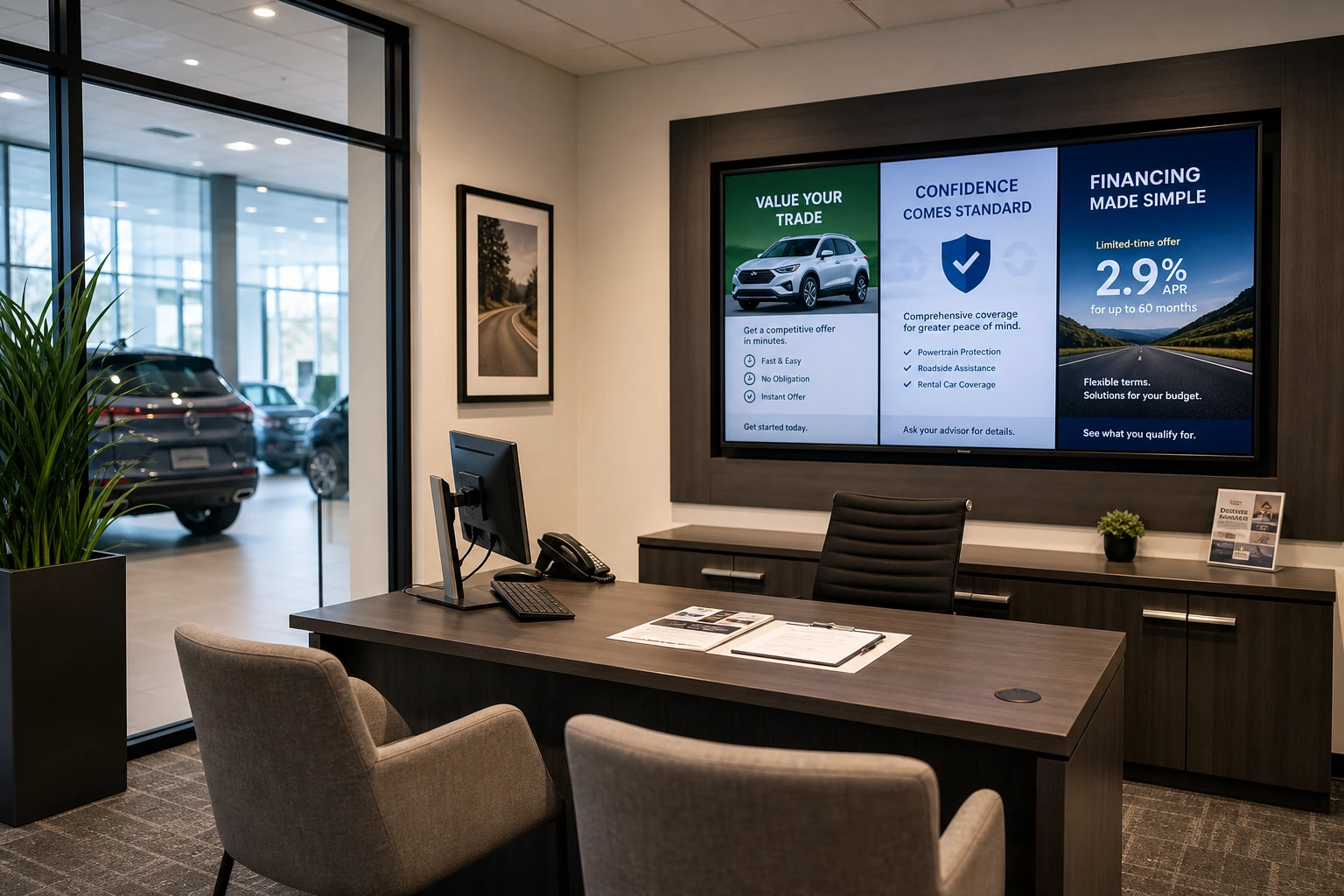
Some dealership offers are easy to say but harder to picture. Extended warranty coverage, GAP, lease-end options, trade-in events, finance specials with shifting terms. A salesperson or F&I manager can explain all of that, sure, but most customers absorb it better when the idea is already a little familiar before the conversation starts.
- Trade-in campaigns feel more concrete. "Upgrade this month" lands better when screens show real examples of current trade-in categories and next-step options.
- Finance offers stop looking improvised. Rotating APR or lease messaging feels more legitimate on managed screens than on desk prints.
- Warranty products become easier to grasp. Visual breakdowns of what is covered, for how long, and why it matters can take some tension out of the pitch.
- F&I conversations get shorter. Customers who have already seen the language once are not hearing it cold.
Restaurants use the same principle with digital menu boards. The first look sells the idea. The staff member closes it.
5. Real-Time Promotions Beat Printed Point-of-Sale Material
Dealerships are full of offers with short shelf lives: holiday events, end-of-month pushes, service coupons, used-car clearance messages, EV test-drive weekends. If those live on printed signs alone, they stay up too long, go out of date, or miss the exact moment they should have hit.
Cloud-based signage fixes that.
- Schedule campaigns by day and hour. Start the weekend event on Friday afternoon, switch to service messaging Monday morning, and retire old creative automatically.
- Swap inventory-led messages fast. If a specific truck line is gone, move the spotlight to certified pre-owned instead of wasting display space.
- Adjust by zone. The showroom can sell vehicles, the service lounge can push maintenance, and the cashier desk can handle pickup reminders.
- Keep compliance cleaner. Finance disclaimers and offer dates are easier to update everywhere at once than on scattered print material.
This is where a platform like Screenivo fits naturally. Pair each screen once, assign the right playlist, and stop treating every update like a tiny signage project.
6. Dealer Groups Need One Content System, Not Six Different Habits
Single-point stores can get away with a little chaos. Dealer groups cannot.
One rooftop uses branded finance slides. Another has local JPEGs on a USB stick. A third leaves the service TV on cable because nobody knows the login. Before long, the customer experience depends less on the brand and more on which manager happened to care.
Centralized digital signage solves that drift:
- Shared templates keep the group consistent. Logos, colors, payment formatting, and offer structure stay on-brand.
- Local teams still control local messages. One store can push a truck month event while another focuses on service capacity or used inventory.
- Rollouts happen once. A group-wide seasonal campaign does not require emailing assets to every rooftop and hoping they display them correctly.
- Operations get simpler. Fewer ad hoc setups. Fewer forgotten screens. Fewer calls asking who changed what.
Hotels run into the same problem across multiple properties, which is why hotel digital signage tends to center on one dashboard with local control.
7. Better Screens Cut Repetitive Questions Without Making the Store Feel Cold
Customers do not just need sales messages. They need orientation.
Where do I check in for service? Where is the cashier? Are there loaners today? How late is pickup? Which desk handles trade-ins? Where is the coffee? None of these questions are hard, but together they burn staff time and make the store feel more hectic than it needs to.
Use digital signs to handle the easy stuff:
- Service check-in guidance. Point drivers to the right lane, desk, or QR code before they stall traffic at the wrong spot.
- Pickup and cashier instructions. Tell people what comes next while they are still waiting, not after they get frustrated.
- Amenity messaging. Wi-Fi, coffee, shuttle details, lounge zones, and working hours all belong on screens.
- Event and emergency notices. Weather closures, shuttle delays, staff training days, and special sales events can go live everywhere in seconds.
The goal is not to replace staff. It is to let staff spend more time on the conversations that actually need a person.
8. What to Look for in Car Dealership Digital Signage Software
Dealerships do not need a complicated broadcast network. They need something the sales team, service team, and ops team will actually keep using.
Look for:
- Fast pairing. Any TV or display should get online in minutes, not after an installer visit.
- Zone-based playlists. Showroom, service lounge, cashier, waiting area, and delivery bay all need different content.
- Remote management. A GM or marketing manager should be able to update screens without walking the floor.
- Scheduling. Campaigns should start and stop on time without manual babysitting.
- Affordable hardware. Common Android TV devices and displays should be enough.
- Multi-location controls. Essential for dealer groups and useful even for a second rooftop.
Good dealership signage software should feel boring in the best way. Plug it in. Pair it. Push the playlist. Move on.
The Bottom Line
Car dealerships already have the screens. The real miss is that too many of them are still treated like background furniture.
Digital signage for car dealerships works when each screen has one clear job: help a shopper compare trims, make the service wait feel useful, explain the finance offer, guide customers through the building, or keep a group-wide campaign consistent across every rooftop. It is a practical upgrade, not a flashy one. The kind that makes the store feel sharper right away.
If you want to see what that setup looks like in a real dealership, get in touch with Screenivo. You can get a showroom or service-lounge screen live in minutes.
Want more examples by industry? Explore our full library of digital signage guides.
Ready to make your dealership screens earn their keep? Start with one showroom screen or one service lounge playlist and build from there.
Sources
- Kelley Blue Book / Cox Automotive — Study: 75% of New Car Buyers Satisfied With Shopping (82% completed more than half the buying process online; dealership satisfaction reached 81%): kbb.com
- J.D. Power — 2024 U.S. Customer Service Index (CSI) Study (average service appointment wait time of 5.2 days for mass market vehicles and 5.4 days for premium vehicles): jdpower.com
- Cox Automotive — What Dealers Are Leaving in the Service Lane (74% repurchase likelihood among buyers who returned for service versus 44% among those who did not): coxautoinc.com
- Journal of Marketing — In-Store Advertising with Digital Signage (8.1% increase in likelihood of purchasing featured products): journals.sagepub.com